– WHAT WE HAVE BUILT
Results that go beyond the theory.
Conservation Without Conflict has delivered meaningful, scalable results on working lands across the country. The accomplishments below represent more than good intentions, they are documented, on-the-ground outcomes that prove voluntary, trust-centered conservation can achieve what regulation alone cannot. They also serve as replicable templates for what comes next.
One of the coalition's most significant accomplishments is the development and first successful implementation of the Landowner Assurance Tool, or LAT. Built through the U.S. Fish and Wildlife Service's Partners for Fish and Wildlife Program, the LAT provides regulatory certainty to private landowners who voluntarily undertake habitat restoration and species recovery activities, without requiring the complexity of traditional permits.
The LAT works by establishing Cooperative Agreements that trigger Section 7 consultation under the Endangered Species Act. The result is a biological opinion that protects participating landowners, and in some cases adjacent landowners, from future regulatory risk. It transforms what has historically been a reason for landowners to avoid conservation into a clear incentive to pursue it.
The LAT has now been implemented in two states, representing the first agreements of this kind in the nation.
– ON THE GROUND
The first two LAT agreements in the country.
These agreements now serve as national templates, adaptable for use across the longleaf range and in other ecosystems nationwide.
- Georgia. The USFWS executed a LAT with the Reese Thompson family that includes regulatory assurances protecting current and future landowners, as well as adjacent properties within 1.5 kilometers.
- Florida. The USFWS and Resource Management Service signed a similar agreement. Following habitat restoration and longleaf ecosystem management, this enabled the historic reintroduction of the listed reticulated flatwoods salamander onto previously unoccupied private lands, a first for species reintroduction on private working forests.
– ACRES AND OUTCOMES
Restoration that exceeded expectations.
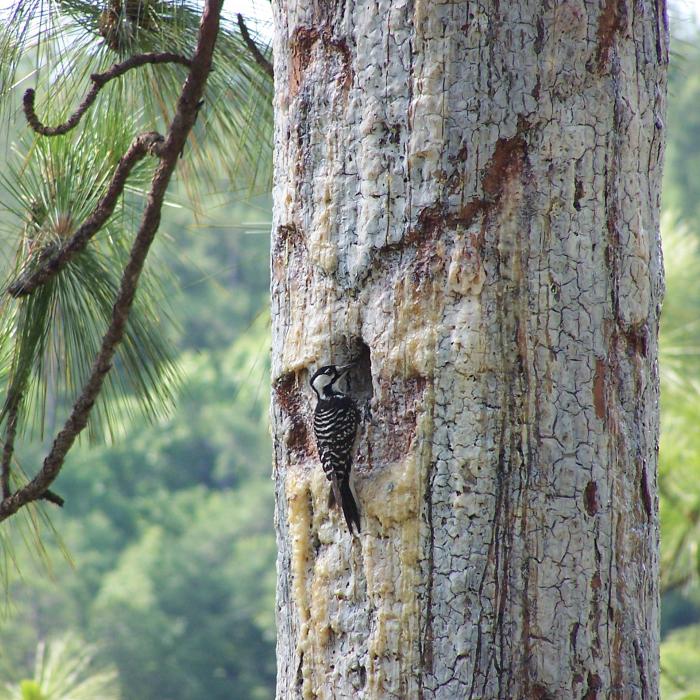
Through coalition initiatives and support from the National Fish and Wildlife Foundation's Longleaf Landscape Stewardship Fund, significant habitat restoration and management has been completed on private lands in Georgia and Florida. Resources were strategically redirected to expand longleaf restoration, resulting in at least 500 acres beyond original projections. Species-focused activities included red-cockaded woodpecker habitat enhancement, reticulated flatwoods salamander reintroduction, and gopher tortoise habitat management. The ecological benefits extend further still: improved habitat quality, carbon sequestration, water resource protection, and maintained working land productivity.
-
500+ additional acres restored beyond original projections
-
3 at-risk species supported
-
2 first-in-the-nation LAT agreements executed

– BUILT TO BE SHARED
Practical tools that help others replicate what works.
These resources have been developed through major coalition events including the 2024 National Summit in Arlington, Virginia, and Wild Goose Chase II in May 2025 at the Aldo Leopold Foundation in Baraboo, Wisconsin.
- Operating Principles refined in 2021, establishing a shared foundation for trust-based voluntary collaboration across the coalition.
- A Step-by-Step Guide published in the WMI Outdoor News Bulletin in 2023, providing a clear roadmap for implementing the Conservation Without Conflict approach.
- A growing Toolkit of best practices, case studies, and templates supporting practitioners across diverse landscapes.
The coalition has built a strong national communications presence through its website, a LinkedIn community of more than 1,100 members, YouTube and X channels, and regular newsletters. Targeted case studies have attracted new partners and deepened engagement across sectors.
On the policy front, CWC has elevated the profile of flexible, incentive-based conservation at the federal level, including recognition within the America the Beautiful initiative and ongoing advocacy for voluntary approaches to the Endangered Species Act.