
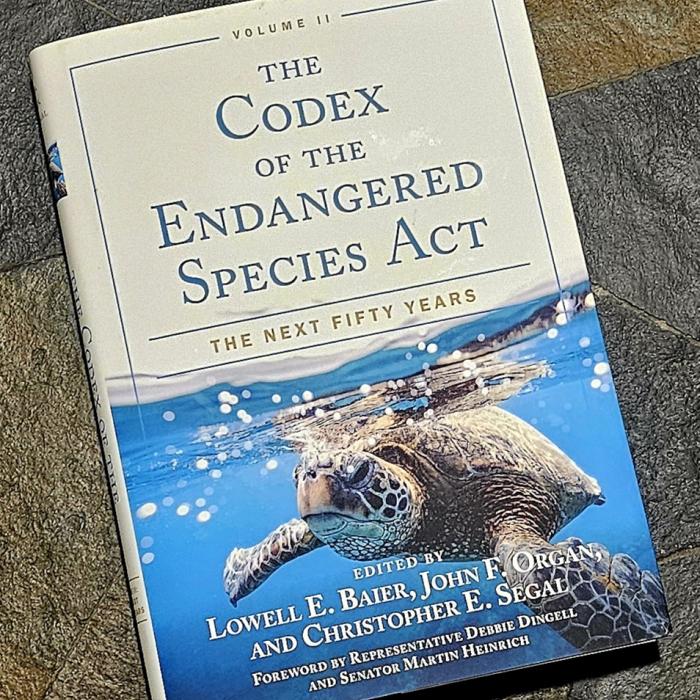
The history below is adapted from Chapter 13 of The Codex of the Endangered Species Act: The Next Fifty Years, Volume 2 (2024), written by James F. Bullock, Jr. and Cynthia K. Dohner. It has been updated to include leadership transitions and implementation milestones through 2026. It is presented here so that partners, members, and the public have a transparent and accessible account of how Conservation Without Conflict came to be — and where it is headed.
– THE HISTORY
Five chapters. One unfolding story.
What began as an idea in Aldo Leopold's writing became a working model in Louisiana, then a national strategy, then a coalition, then a track record. Each chapter below covers one stage of that progression.
The ideas behind CWC predate the organization by nearly a century.
Collaborative conservation in the United States has deep roots. Early efforts following the widespread habitat loss and market hunting of the late nineteenth century gave rise to institutions that shaped the field — the Boone and Crockett Club, convened by Theodore Roosevelt in 1887, the Cooperative Wildlife Research Unit Program, and the National Wildlife Federation, among others.
But the most enduring intellectual foundation came from Aldo Leopold. In his 1930 introduction to the American Game Policy, Leopold stressed the necessity of "full and equal partnership with the landowner and the protectionist." In his 1936 essay "Threatened Species," he articulated a vision of voluntary, distributed stewardship — rangers, wardens, farmers, and others entrusted with conserving species remnants not because the law required it, but because they chose to.
That idea — that lasting conservation happens with people, not despite them — planted the seed for what eventually became Conservation Without Conflict.
A threatened listing became a coalition, and a template for everything that followed.
In June 1990, the U.S. Fish and Wildlife Service proposed listing the Louisiana black bear as threatened due to habitat loss and human exploitation. Private forest landowners, fearing regulatory consequences, worried it would become the "spotted owl of the South."
What happened next was different. Following a meeting hosted by the Louisiana Forestry Association, the Black Bear Conservation Committee was formed — growing from 18 initial participants to a coalition of more than 70 private landowners, state and federal agencies, conservation organizations, and academic partners. Their explicit goal was to restore black bear populations to the point that listing would prove unnecessary. Subcommittees addressed habitat and management, research, education, and funding.
Although the subspecies was listed in 1992, a critical provision in the final rule recognized that normal forest management practices were compatible with bear habitat needs — easing landowner concerns and keeping working lands working. The results speak for themselves. By the time of delisting in 2016, occupied bear habitat had increased fivefold, the number of viable populations had grown from three to four, and the bear population had doubled.
The Black Bear Conservation Committee proved that private-public partnerships could deliver real conservation outcomes while respecting the economic realities of working lands. It became the direct model for what followed.
A regional strategy grew into a national movement, and got its name.
In 2010, the USFWS Southeast Region faced an unprecedented challenge — a mega-petition requiring evaluation of more than 400 species, potentially more than doubling the number of listings in the region. Under Regional Director Cynthia Dohner, the region responded not with more regulation but with a proactive, voluntary conservation strategy focused on keeping species off the list in the first place.
In 2011, the USFWS Southeast Region and 15 southeastern state wildlife agencies launched the At-Risk Species Conservation Strategy. Leopoldo "Leo" Miranda-Castro joined the Southeast Region senior staff as Assistant Regional Director for Ecological Services, taking on direct responsibility for implementing the effort and encouraging voluntary conservation tools that protect private land interests and provide regulatory certainty.
Meanwhile, five large private forest landowners — managing a combined 12.5 million acres — approached Jimmy Bullock to engage Dohner about a new partnership. What followed was a series of meetings, pilot projects, and agreements that demonstrated working forests could be managed in ways that actively benefit at-risk species. By 2016, that partnership had expanded nationally. The USFWS Directorate endorsed it. Congress commended the model in two successive fiscal year reports and urged its nationwide expansion.
In 2016, senior USFWS leaders in the Southeast gave the approach its name: Conservation Without Conflict. Implementation began across all regions in 2017.
A single meeting became a national coalition with structure and leadership.
On August 28, 2017, Cynthia Dohner, Wendi Weber, and James Cummins of Wildlife Mississippi held the first formal Conservation Without Conflict meeting in Atlanta, Georgia. About 30 experts from government and industry attended. The central argument was simple: private landowner economic viability and species conservation need not be mutually exclusive. Participants unanimously agreed to expand the effort and hold a national summit.
The first Conservation Without Conflict National Summit took place March 12-14, 2019, in Washington, D.C., with approximately 60 participants representing state agencies, the Department of Defense, the Western Landowners Alliance, The Nature Conservancy, and many others. A bipartisan congressional panel further elevated the approach.
In April 2019, the Theodore Roosevelt Conservation Partnership, the National Alliance of Forest Owners, and the Wildlife Management Institute pledged a three-year funding commitment to launch a national campaign. Dr. Steve Williams offered to house the coalition under the WMI umbrella — a relationship that continues today.
In December 2020, a Steering Committee selected Dr. Lauren Ward as the coalition's first Executive Director. Under her leadership in 2021, the coalition more than doubled its funding, hosted a second national summit, and secured recognition in federal reports on the America the Beautiful Initiative as a promising vehicle for motivating voluntary conservation by farmers, ranchers, and forest owners nationwide.
New leadership turned principle into results on the ground.
In February 2023, the Wildlife Management Institute announced the selection of Leopoldo "Leo" Miranda-Castro as the coalition's new Executive Director. Miranda-Castro, who had recently retired as USFWS Southeast Regional Director, brought deep experience in voluntary public-private conservation partnerships and a personal history with the CWC approach stretching back to its earliest days.
Under his leadership, the coalition has focused on translating principles into scalable, on-the-ground outcomes. A central development has been an innovative pathway combining the USFWS Partners for Fish and Wildlife Program with Section 7 consultation under the ESA — enabling programmatic agreements that provide regulatory certainty to private landowners without requiring traditional permits, often achieving signed agreements within two to six months.
A flagship demonstration of the approach occurred in January 2025, when the first successful reintroduction of larval reticulated flatwoods salamanders on private working forest land took place in Santa Rosa County, Florida — the result of a first-of-its-kind Partners for Fish and Wildlife Program agreement executed in October 2023. The project achieved its conservation objectives with no regulatory risk to the landowner. Partners recognized it as establishing a new standard for private-land species recovery.
In August 2023, Miranda-Castro published a step-by-step guide to collaborative conservation in the WMI Outdoor News Bulletin, drawing on coalition case studies and field experience. In February 2026, he delivered the plenary address at the Missouri Natural Resources Conference, further elaborating the framework and highlighting successful models from the Louisiana black bear recovery to the PFW pathway.
The coalition continues to grow — in membership, in reach, and in demonstrated results. The story is still being written.
